
Delaware Avenue History Trail - Part 1

The Delaware Avenue History Trail is a self-guided walking tour (to be occasionally conducted in person) that consists of twenty-five historically significant stops, beginning at Adams Street and Park Drive, through Wilmington and Brandywine Cemetery, up Delaware Avenue and ending at Rockford Tower.
As an "old" American city, every inch of Wilmington has interesting history.
This walking tour tells the stories of key people and places that shaped one particular section and has the following goals:
(1) Build Stronger Sense of Place
One way is the use of interesting historic story-telling signage (even if merely QR codes). Towns like New Castle and Havre De Grace do this; only the Riverfront does this in Wilmington.

(2) Encourage Walkability and Street-Level Vibrancy
Going places by foot instead of car is more appealing when captivating stories about key people, places and buildings etc have been effectively promoted and known. And when people are seen out and about doing things it creates a sense of vibrancy that adds to the appeal of a given location.
(3) Promote More Excitement About Being in Wilmington
Better promotion of local history will help increase civic participation and pride about living here, not to mention encouraging tourism and outside visitors.
Part Two covering Trolley Square and 40 Acres through Rockford Tower will be published in January.
Special thanks to Bill Knightly, Ed Richi, Scott Reese, John Flaherty, Janet Lindenmuth, Paul Smith, Francena Shalfant and Jeanne Nutter for helping shape Part One.
Nathan Field, October 2026
DE Ave History Trail Map - Pt 1

(1) Lenape trail and fishing grounds - Time immemorial
(2) Stiddem's first mill on the Brandywine - 1660s
(3) Will Caesar Rodney Attack? - 1777
(4) Wilmington and Brandywine Cemetery – 1842
(5) The Cross Keys Tavern – 1736
(6) Building Delaware Avenue - 1863
(7) The New Century Club – 1892
(8) Hoxter's Brandywine Restaurant - 1906
(9) Tribute to a Wilmington Animal Lover – 1871
(10) Local Artist Makes it very Big! - 1883
(11) Historian of the DE Suffrage movement – 1871
(12) Neighborhood patriot saves the Monument - 1870
Click on title to go directly to a stop
Stop 1 - Lenape Trail and Fishing Grounds

A stroll anywhere in Brandywine Park is to walk in the footsteps of the Lenape indigenous people that lived here since time immemorial.
The Lenape revered the Brandywine as an essential lifeline, trade route, and seasonal fishing ground within their more than one million-acre homeland, Lenapehokink which was divided into three distinct clan districts: Turtle, Wolf & Turkey.
Stop 1 is in close proximity to one of the major hubs of the Turtle Clan (Unami). In Lenape Cosmology, the Great Turtle represents the earth itself, carrying the world on its back after creation. The Turtle Clan was the most senior, respected, and influential of the 3 Lenape clans, and through hereditary leadership, the principal sachems (Chiefs) were chosen from the Turtle Clan.(1)
While there is no archeological record (YET), it is very highly probably that this exact stretch of the Brandywine River was utilized by the Lenape to sink their canoes into for winter as it is where the Fall Line of the Piedmont Plateau meets the flat tidal water of the Atlantic coastal plain. That provides the ideal consistency of soft silt and mud to submerge and pack a canoe safely for winter.
Master canoe makers, the Lenape hollowed out tulip trees by controllably burning and scraping the charred interior out until they had the desired depth and thinness. To keep them from drying out and cracking in winter’s cold, they buried them where they needed them for harvesting the massive schools of shad that entered the Brandywine River from the Delaware River yearly in mid-to-late March.

Source - American Swedish Historical Museum
The Lenape and the Swedes, the Wilmington area's first European settlers, had a relatively peaceful coexistence and mutually beneficial trading relationship for much of the 1600s.
That did not last. Although William Penn spoke Unami and believed that the Lenape were also the children of God, the peaceful relationship disintegrated shortly after his death in 1718. Because economic capitalization was more important to Penn’s sons and investors than the Quaker religion, by the 1750s the Lenape had mostly been pushed out of New Castle and Chester Counties and migrated Westward.
In recent years, local environmentalists have been focused on restoring the flow of Shad up the Brandywine which has been prevented since the river was dammed in the colonial era to build mills. They host an annual festival on the Brandywine called Shadfest to highlight their progress.
Stop 2 - Stiddem's First mill on the Brandywine
This is the site of the first mill on the Brandywine. It was built in about 1670 by Swedish settler Timen Stiddem (1610-1686) and his eight sons and two grandsons.
The family established the mill on their homestead along the Brandywine right where the land met the water's edge at Stidham Ford—the shallow crossing point that aligned with what eventually became modern-day Adams Street.

Stiddem first came to (what would become) modern day Wilmington in 1638 as a member of the Kalmar Nyckel expedition that aimed to create a Swedish colony in the so-called "New World".
With a formal job title of “Barber-Surgeon” his duties included setting broken bones, pulling teeth, performing an occasional amputation, while also cutting hair and providing shaves.

Site of Swedish landing memorial and excellent museum- East 7th St, WIlmington
New Sweden (1638-1655) was always a small colony that struggled to attract more than a few hundred settlers. As the local doctor, Stiddem was likely familiar with all its residents.
That included Antoni Swart, the first documented African in Delaware. He arrived here also in 1639 on a different ship after being either purchased or kidnapped in the Caribbean.
Swart became a free man and like Stiddem worked directly for Governor Printz (namesake of the modern boulevard). He was a skilled boatsman which was an important job given that New Sweden consisted of isolated settlements reachable primarily by river travel.
Stiddem Navigates New World Power Politics
After several long journeys back and forth from Sweden during the 1640s, including one that ended in a disastrous Caribbean shipwreck that killed his wife and two children, Stiddem was ready to settle permanently in the New World. He remarried and had nine more children.
New Sweden, however, was in its last days.
The Dutch always considered their Swedish rivals to be illegitimate squatters in Wilmington but usually lacked the manpower to do anything about it. That changed in 1655. They sent a “massive” force of three hundred soldiers down from New Amsterdam (modern day New York) and took over the Swedish forts in New Castle and Wilmington.
The terms of surrender were fairly lenient. The main Dutch objective was overall political control and they had an interest in ongoing local prosperity. Stiddem and nineteen others simply pledged loyalty to the Dutch and went about business as usual.
During Dutch rule, Stiddem gained possession of three hundred acres along the South bank of the Brandywine, about 1/3 of the land covered by modern Wilmington. (2) He built his house at the modern site of Howard High School (pictured below).

This excellent map was produced for the 1937 book "Wilmington Delaware Under Four Flags, 1609-1937."
In 1664 when the English forcefully wrestled control of the East Coast colonies from the Dutch, Stiddem and most local residents took the same pragmatic path. In 1671 the Duke of York’s agent granted him a deed recognizing ownership of the land in the English legal system that he already possessed along the Brandywine.
Around this time, the Stiddems begin to Anglicize their name to Stedham or Stidham.

Source - Hagley Research Library. Picture of Stiddem's house at 14th and Poplar shortly before being torn down in late 1800s.
Prominent members of Wilmington Society for the Next 150 years
Timen’s descendants were prominent Delawareans and land owners well into the 1800s. At least sixty-four are buried in Old Swede’s Church on E. 7th St.
As Wilmington became a town in the 1730s the land along the Brandywine rose in value and was gradually sold off and was used for mills.
Though Stiddem's mill itself burned down, the site laid the groundwork for Wilmington's future as a global milling capital. Oliver Canby purchased the property and the historic mill race was initially constructed around 1743. He installed the water channel to divert and harness water power from the creek to power three mill sites which produced what became internationally famous "Brandywine Superfine" flour.
Stop 3 - Will Caesar Rodney Attack?
After a short walk up the hills of the Wilmington and Brandywine cemetery, you reach stop #3.
This was the site of British and German units, awaiting an expected attack by the Delaware militia led by Caesar Rodney in the days following the Battle of Brandywine.

View from British and Hessian fortifications facing Brandywine - September 1777 -
The British Win at Brandywine, Capture Wilmington
In late August 1777, fifteen thousand Red Coats under the command of General William Howe landed by ship at Elkton, Maryland and began marching towards the Patriot capital of Philadelphia. Howe hoped to force a decisive battle against the Continental Army that would maybe even end the rebellion once and for all.
On the 11th of September, he outmaneuvered George Washington and the British won a rout at the Battle of Brandywine.
However, they suffered significant casualties and needed a spot to regroup. Wilmington seemed the obvious location.
British units marched down the Concord Pike and easily captured the town. As a bonus they nabbed a VIP prisoner, John McKinley, the Governor of Delaware, who would be held prisoner for the rest of the war.

Not part of this tour but Washington's Military headquarters September 1777 - still standing at 1803 N. Market and is worth a visit.
Will the Americans Try and Retake Wilmington?
The British thought so. They believed that Caeser Rodney’s Delaware militia had eight-thousand armed fighters at its disposal. (2)
As a result three regiments, consisting mostly of German mercenaries, were sent to defend the town. Overnight, the twelve-hundred residents of Wilmington were occupied by twenty-five hundred enemy soldiers.

Thanks to a excellent map drawn by the German commander we know exactly where they were positioned: right here!
It was believed that any attempt to retake Wilmington would come from the North (today - Concord Pike, The Triangle, Alopocas, Brandywine Hills, Fairfax etc).
Therefore, the hills corresponding to modern-day Broom, Harrison and Rodney Streets, between Delaware and Lovering Avenues were strongly fortified and defended by the British and their allies:

Stop #3 marked by red X.
Why the View Today from Stop #3 was Much Different in 1777
Someone standing here today as part of this tour might reasonably wonder why this was considered a good defensive position? The trees everywhere make it hard to get a good view of Park Drive and there is no view of the Brandywine River.
The response is that in 1777 things looked much different.(3) In colonial times, the common practice was to remove trees to facilitate farming or to be used for building, furniture or fuel. The hills overlooking today's Brandywine Park looked roughly similar to this:

Which meant that the Germans positioned here had a completely unobstructed view a half mile or more in every direction. Any Patriot attack would have immediately been sited long before they came anywhere near Wilmington.
The Attack Never Comes – Washington’s Units Take The Same Spots

In reality, the Delaware militia had no ability to retake Wilmington. The New Castle Country members in particular failed to answer the call to help Washington before or after Brandywine, much to Caesar Rodney's embarrassment. The most they did was isolated sniping at Hessian sentries.(4)
The British soon turned their attention to Philadelphia. In October they evacuated the units from Wilmington to consolidate their forces elsewhere.
Washington, however, wanted to make sure there was no possibility of enemy forces retaking the town. He sent 1,500 to defend these same hills, taking over the same spots that had just been vacated.
Stop 4 - Wilmington & Brandywine Cemetery
Fast forward about 60 years for the fourth stop on the Delaware Avenue History Trail. If you stood here at any point through the 1830s, you would have been in the countryside. But Wilmington in the 1800s was experiencing rapid growth.

In 1777 twelve hundred people lived in Wilmington. By 1830 the population reached 6,628 and doubled again to 13,979 by 1850.
As a result, by the mid 1800s the existing churchyard cemeteries in town were running out of room.
A new cemetery is founded
In 1840, Samuel Wollaston, a descendant of the early Swedish settlers, raised the funds to buy the land and establish the cemetery.
The Wilmington and Brandywine was notably Delaware’s first non-sectarian cemetery meaning that anyone of any faith could be buried here. It was designed in the style of the rural cemetery movement originating in Paris.

Rededication of Revolutionary War Mass Grave
A unique feature of the W&B is that many people buried here were transferred here from other Wilmington cemeteries that once existed “downtown.”
This is illustrated by a moving ceremony that took place in September of 2026 to install a permanent memorial for British and American soldiers killed during the War of Independence.
During the war at least sixty soldiers were buried at a cemetery that once stood next to the future site of Rodney Square. As Wilmington grew in the 1850s, such land - once rural in the middle of nowhere - had become prime real estate.
These war graves were moved to a mass grave at Wilmington and Brandywine then largely forgotten. The exact location and identities were recently discovered and as part of the Wilmington 250 ceremonies, a permanent memorial was dedicated.
The 1917 Widening of Delaware Avenue
By the late 1800s Wilmington was a true city with population approaching one hundred thousand residents. Development surrounded the cemetery on all sides and Delaware Avenue started to take some of its land.

Source - Hagley Research Library. Photo from about 1900 before the first major widening in 1917. These are likely students at the WIlmington High School then across the street
Wilmington at the turn of the 20th century was a city of surging ambition. The Dupont Company decided to stay here rather than move to Philadelphia or New York and built a shiny new headquarters downtown. City leaders were investing time and energy in building Rodney Square. The automobile era was entering full swing.

City leaders also believed more modern (ie wider) streets were needed to accommodate the automobile era. Eminent domain was applied all along Delaware Avenue. Ten feet was seized from the cemetery in exchange for ten thousand dollars.
The ornate gatehouse was lost:

Above - Gatehouse lost to street widening. Colorized via AI . Below - Same view of entrance, same tree 100 or so years older

But 1917 wasn’t the end of street widenings. Delaware Avenue and Adams Street was widened again in the 1960s to allow for the path of I95. More land, especially along Adams Street, was taken via eminent domain from the cemetery. All of the graves of more than one hundred soldiers who died during the Civil War had to be dug up and moved.

Before and After 1960s era widening

The cemetery is open each day from 8am to 5pm. Walkers and historians are welcomed.
Stop 5 - Site of The Cross Keys Tavern
The Cross Keys was a Wilmington institution with major social, political and economic importance at this approximate spot from 1736 through 1861.(1) The Tavern stood at the intersection of Kings Road (modern Adams Street), the main colonial era highway and Lancaster Road. Travelers were greeted by two bright yellow crossed Keys, an 18th century symbol associated with roadside taverns and hotels.

The Many Functions of the Wilmington Cross Keys
Picture a multi-purpose combination of the following: an I95 rest stop, hotel, Pep Boys, gas station, community center, your favorite neighborhood bar, political meeting spot and voting booth, all in one.
The rural location just outside of town was perfect for farmers headed to Wilmington’s town market. It offered pasture lots where cattle and sheep could be kept overnight with abundant grazing available.[2]
Early lodges, political caucuses, and patriotic societies held meetings here. Any inspiring politician running for office in the 18th and early 19th century would have canvassed for votes at the Cross Keys.
Not to mention the circus. Given its rural location and extensive stabling, the Cross Keys was the “Go-to” spot for traveling circuses, who performed often for weeks at a time.[3]

No photos exist and I can't find any sketches but Wilmington Cross Keys probably looked similar to the Bucks Country Cross Keys - built in 1756
The Civil War of 1777 at the Cross Keys
That America's war of Independence was also a civil war was on full display at the Cross Keys. A significant portion of the population throughout the thirteen colonies opposed the rebellion and actively aided the British. This was especially true in the Delaware and Philadelphia area.
Washington's official papers includes an order announcing a court martial at the Cross Keys for a prisoner named Lt Troupe:

The lieutenant's exact fate and crime is unknown. However, one distinct possibility if not probability is that Troup was a recruiter for Loyalist militia forces.
Two weeks later, when the British captured Wilmington, the willingness of local Loyalists to get revenge on town Patriots was on full display. They outed several members of the plain-clothed Delaware militia living in town to the arriving Red coats who locked them in the basement of the Cross Key stables and detained them under abusive conditions for nearly sixty hours.(4)
Only after protests by leading Quakers, seen as neutral, were the men moved to the Presbyterian Meeting House on Market Street (moved to Brandywine Park in 1916 at West St) where they perhaps were equally mistreated.
“No Familiarity permitted with the attractive daughters”
There were many proprietors over the Cross Key’s long history. Perhaps the most colorful were the last, the Schofield family, John and Sarah and their three daughters. They ran the place for the final twenty years.
A 19th century Delaware encyclopedia described John as a “very fat Englishman” and he was a dynamic entrepreneur. [5] He worked as a spindle maker and mechanic at the old barley mill on the Brandywine near Happy Valley.
Most importantly for the running of a tavern, the Schofields had a special skill in making good ale.

Delaware Inquirer - 1859
Sarah Schofield took over upon her husband's death. She was assisted by her three attractive daughters who were “witty, could play the piano, and could carry on a lively conversation." [6]” Not surprisingly, young men from the town were frequent patrons.
However, Mrs. Schofield "permitted no familiarity" with the girls who worked the bar and the place maintained a good reputation.
Last Days of the Cross Keys – Three Main Reasons
By the 1850s it was losing money and "merely a drinking saloon." [7]
The rise of railroads and canals as a means of transporting goods to market decreased the importance of the hotel and "way station" aspect of the Cross Keys. As did a 1859 a fire that destroyed the stables. (8)
However, Wilmington’s continued growth is what ultimately killed the Cross Keys.
In 1853 municipal boundaries were extended to what is now Union Street. Ten years later City Council renamed Kennet Road “Delaware Avenue” and passed an ordinance widening Delaware Avenue by five feet on each side to make way for a planned trolley system. That same year Joshua T. Heald bought the Cross Keys and demolished it to allow for the wider road.
The Wilmington icon was quickly replaced by the 900 block of Delaware Avenue, fancy homes of Wilmington residents.

Eighty years later, all these houses would be torn down to make way for I95. Such are the layers of history.
Source - Hagley Research Library - Dalin Aeiral Sruvey

Former grounds of Cross Keys
Next time you sit at the I95 off ramp, waiting to turn onto Delaware Avenue, think of the old Cross Keys, site of thousands of drunken revelees, visits by George Washington and other founders, election campaigns, colonial tortue chambers, road site visits, and Circus events for over a hundred years of Wilmington history.
Stop 6 - Joshua Heald and the building of "Delaware Avenue"

Source - Delaware History Society
The Delaware Avenue History trail can’t go any further without profiling Joshua T. Heald, a 19th century urban planning visionary and politician.
Starting in 1863 Heald was largely responsible for the development of the neighborhoods of Trolley Square, Forty Aces up through the Highlands to Rockford Tower. He implemented similar projects in Elsmere, Southbridge and the 9th ward.

In 1863 this area was was farmland that had not changed much since Timen Stedham owned it 200 years earlier. Within thirty years, the modern footprint of today was mostly in place:

1848 city plan - Cemetery is far edge of development
Farm to City – typical 19th century story
Heald was born on a farm in 1821 in Hockessin. He was a Quaker whose family emigrated to the Chester County area around the time of William Penn. [1] In 1838 he came to Wilmington to work as a bookkeeper at a newly founded shipbuilding company. By age 22 he had married and had set up his first business, a bookstore on Market St.
By 1861 the store was operating at the site of today's La Fia restaurant. If you wanted to buy a new book in Wilmington on the eve of the Civil War, here were your choices:

Newspaper - February and March of 1861
Heald’s Delaware Avenue Vision: Supply + Demand
Heald loved walks along the Brandywine and could not help but notice the huge supply of immediately accessible land close to the existing city.[1] He also was well aware of a major housing shortage in Wilmington during this period given the town's explosive population growth.
Here's how bad the shortage was:
In January of 1866 there was not one house to be rented in the entire city. In March only a two-story frame house opposite Old Swedes Churchyard could be found.[2]
There’s one catch – virtually all the land was owned by Philadelphia resident Joseph S. Lovering. A Quaker merchant, Lovering was born in Wilmington but moved to Philadelphia shortly after his birth where he made a fortune refining sugar and syrup.[3]
In 1860, Lovering designated Heald to be the agent for the urban development of the Shallcross farm. Heald did the work. Lovering got a percentage of the sales.
Pre-Divided Lots, Auctions & FOMO
Heald pre-divided the land into lots which were then auctioned off to individual buyers. This also allowed for the uniqueness and variety of the houses since there were many people building the homes (compare to the typical modern housing development built by one entity where houses generally look the same).
The subtle use of FOMO – Fear of Missing Out – was used to raise as much money on the land sales as possible:

Source - Delaware Gazette, September 26th 1865
Creation of a Trolley System.
In 1864 Heald was the founding President of the Wilmington City Railway company. This new concept of mass public transportation allowed people to live far further away from their employer than ever before, opening neighborhoods such as 40 Acres for creation. Much more on this in the next section of this walking tour covering Trolley Square and Forty Acres.
street Scapes before vs After

Source - Delaware History Society - view of 900 block n 1930s after major street widening of 1917. Same site today below:


Source - Delaware History Society
Source - Delaware History Society


Source - Delaware History Society


When Heald died, somewhat suddenly in 1887, possibly from overwork, a line in his front page obituary said it all:

Wilmington Morning News, July 23rd 1887.
Stop 7 - The New Century Club
1014 is the former site of an exclusive women's club that (just barely) survived the construction of I95 and is the only 19th century building remaining from the 900 or 1000 blocks of Delaware Avenue.

Through the 1880s, women were largely excluded from participation in politics and public affairs. This was changing in the post-Civil War era as many increasingly sought greater civic involvements. One way was through the establishment of women’s clubs.
The New Century Club of Wilmington was formed in 1889 and initially met at Eden Hall downtown. As membership quickly surged the need for a more permanent home was obvious. The club quickly raised the funds (about a million dollars in today’s money) to purchase the land and build their own Club house.

Minerva Parker Nichols (pictured above) was hired as the building’s architect. She had recently designed the Philadelphia New Century Club clubhouse and was one of the first prominent female architects in the county. She was also quite young and only 32 when this project was completed.
Although women were formally excluded from voting, the New Century Club had significant political clout. As membership was the elite of Wilmington society, male politicians could not ignore their concerns.[1]
The Club played a major role in promoting social reform and engaged in extensive lobbying of the State legislature. They were responsible for public school lunch program, introduction of manual education in public schools, compulsory school laws, and laws to protect child and female factory workers and the creation of the state's first reform school for women.[2] It also played a major role in the Suffrage movement.
In 1975, the club disbanded due to declining membership. Since 1982 it has served as the Delaware Children’s Theater.
Stop 8 - Hoxter's Brandywine Cafe

The next stop on the Delaware Avenue History trail is a short walk across the street. In 1905 the high-end Brandywine Apartments were the newest addition to the city’s most prestigious neighborhood.
It is here where Eli H. Hoxter established himself as a young African-American entrepreneur and owner of one of the longest running black owned catering businesses in Wilmington

A Young Man on a Mission
Hoxter was born in 1880 in Frederica, near Dover in Kent County. Like many ambitious rural Delawareans during this period, he sought the greater economic opportunity offered in a city of Wilmington’s size and moved here as a young man. It is said he received some of his training under a French chef.
By 1899, barely nineteen years of age, Hoxter had established a catering company. The New Century Club was where he started cooking professionally and probably where he earned his reputation as an excellent chef. In 1902 he married Hope Burns and they lived in the 900 block of Wilson St near where the Walnut Street YMCA was eventually located.
Hoxter clearly had a knack for running a catering company and his reputation spread around town. In 1905 he opened a thriving restaurant on the ground floor of the Brandywine Apartments:

In terms of African-American history, Hoxter while perhaps less known than others, was a leading member of the Mens Business League. He helped organize a two day visit to Wilmington by National Civil Rights leader Booker T. Washington in the summer of 1910.
Hoxter passed away in 1964 and was active until a few years before his death. His home and company headquarters were located in the 1600 block of Pennsylvania Avenue. Hoxter’s would last several more decades after the founder’s death. The new management even branched back into the sit-down restaurant business in the 1980s, running “Hoxter’s” at the current site of Kid Sheleens.
Stop 10 - Local Artist Makes It Very Big

In the late 1800s Howard Pyle was a globally celebrated artist and by far Wilmington's most famous resident. A true "local," his decision to build his studios here instead of more prominent arts capitals such as New York or Philadelphia, is a major reason why Wilmington has a strong art scene today.
The Post-Civil War Printing and Publishing Revolution
Pyle was born in 1853, a perfect year to be born for someone with his skill set.
Before the Civil War, there were seven hundred periodicals in the US. By 1880 there were five thousand. More importantly, changes in printing technology allowed the inclusion of captivating images to attract readers which created limitless career opportunities for illustrators like Pyle.
He spent three years establishing himself in New York City in the late 1870s, publishing hundreds of articles for national publications. In 1881 he moved back to Wilmington, got married and two years later had enough money to build his studio right here. He cultivated the Brandywine School and many of his students would go on to be major artists in their own right:
Pyle, Bancroft and the Founding of the Delaware Art Museum
By 1900, Pyle was the most sought out illustrator in the County. The last ten years of his life, he was making no less than $25,000 a year, about a million dollars in today’s money.[1] He had just moved his family to 907 Delaware Avenue, one of the toniest blocks in the City.

907 is 2nd from left pictured in the 1930s after the 1917 street widening.This whole block was torn down to build I95..
Pyle lived life large. As soon as money came in, it was spent. When Pyle died suddenly in Italy in 1910, his wife and six children were shocked to discover there was hardly any money in the bank.[2]
To help the family, several concerned citizens founded the “Wilmington Society of the Fine Arts,” to raise cash to buy some of these unsold paintings. They found a temporary home on the 2nd floor of the Wilmington Main Library downtown.
Meanwhile, across town, factory owner Samuel Bancroft (1840-1915) was accumulating a huge collection of 19th century British artists known as the Pre-Raphaelites. In 1935 his family donated that collection to the Society of the Fine Arts, along with land to build a museum. Thus in 1936, the Delaware Art Museum was founded – with the Pyle and Bancroft collections forming its foundations.
And just by chance - the DAM through Fall 2026 is hosting an exhibit on Pyle and Bancroft:

For art lover’s the Pyle studio lives on today as an active artist’s group. It is frequently open to the public, usually the first Friday evening of every month.
Stop 9 - Tribute to a Wilmington Animal Lover
Since 1871, in different forms, this has been the location of a monument to 19th century Wilmington animal rights activist Ferris Bringhurst (1837-1871) who is considered the founder of the Delaware Society for the Prevention of Cruelty to Animals.


In the mid-19th century, animal abuse was common. Horses and cattle were overworked, driven to exhaustion, denied water etc. Animal baiting, dog fights, cock fights was a common form of entertainment.
However, attitudes were beginning to change. The key player in Wilmington was Ferris Bringhurst. In early 1871 he gathered a group of animal lovers at his house at 808 West Street to plan a new society aimed at improving the welfare of animals.[1]
Shortly after that meeting, Bringhurst and Co announced the creation of the Wilmington Fountain Society. Their basic idea was to provide “rest stops” for animals (and people too) to obtain clean water from fountains placed around town. Keep in mind - that was quite novel and generous in an age where no home had indoor plumbing!
Sudden Death – Honored with a Memorial Fountain
Shortly after founding the WFS, Bringhurst was killed in an industrial accident. Devastated society members honored their friend and founder with a Memorial fountain which stood at the Delaware and Pennsylvania Avenue split for the next ninety years.

Delaware Tribune - August 10th 1871
1960s Vision Challenges The Victorian Era Fountain
In the post-War period, Wilmington – like cities everywhere - was struggling. Significant numbers of people were moving to the suburbs. Civic leaders thought a new footprint was needed to make the city as attractive as possible in this new era.

Using his own money, Frank Dupont purchased the adjacent apartment building, tore it down and designed a modern park to "act as an attractive gateway into the center of our city.[2]” He then gave the park to the city.
Dupont's vision did not include room for the Victorian-era fountain. However, he did commission legendary Wilmington artist Charles Parks to design a statue titled "Boy with Dog" that maintained the historic tribute to Ferris Bringhurst:

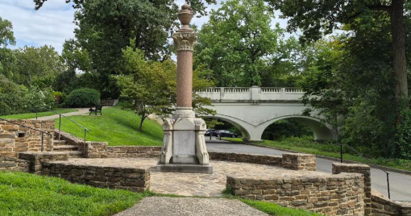
Prominent city resident W.W. “Chick” Laird deserves the credit for storing the monument until a new home could be found. In the late 1980s thanks to Laird and the efforts of the Delaware Avenue Community Association it found a new home in Brandywine Park:
Stop 11 - the De Vou Mansion
Built in 1871, the mansion at 1311 Delaware Avenue housed the De Vou family. Mary (1868-1949) was a key player in the Suffragist movement, and served as its semi-official historian.

The original occupants were Victorian-era entrepreneur and politician, James Laird De Vou and his wife Anna. They moved here from 3 W. 4th St in Quaker Hill. James played a major role in Delaware Avenue's development (especially in the 40 Acres area - more on that in Part Two).

Source - Encyclopedia of Delaware - James, Anna and Mary

Name plate in sidewalk datinig to early 1870s
The focus of this stop is on their daughter Mary. An 1887 graduate of the Wilmington High School, she became a member of the New Century Club and by her mid-20s was on the Executive Committee, illustrating her strong leadership skills.
Historian of the Delaware Suffrage Movement
By the mid 1890s, Mary had joined the suffrage movement.
When the politicians in Dover, realized that the State’s constitution – first written in the colonial era – needed a rewrite for more modern times in 1897, there was some hope that suffrage would be written into the new Delaware constitution.
Mary was part of a petition drive gathering signatures from 1,228 women and 1,592 men trying to convince legislators to take that step. They forced a rowdy hearing on the matter in Dover but suffrage was not added to the new State constitution.
The movement then focused on lobbying for a Federal Amendment to the US Constitution. Mary took part in the great suffrage parade on March 3rd 1913, timed for the day before Woodrow Wilson’s inaugration (and she likely had a passing acquaintance with the new President who had given multiple speeches at Delaware Avenue's New Century Club).

Second from left
A skilled writer with a strong sense of history, Mary was asked to write the official histories for various publications and wrote a key chapter titled “The Women’s Suffrage Movement in Delaware.”
Another key interest was botany. She was a board member of the Natural History Society of Delaware. In Mary’s day, the home at 1311 Delaware Avenue had a backyard that extended all the way to Gilpin Avenue. She let the plants grow wild so she could study them. No pictures are known to – but the entire parking lot was a garden:

When Mary died at age 81, the newspaper coverage was a testament to her long active life in Wilmington civic scene:

Stop 12- Soldiers and Sailors Monument
This iconic memorial to those who died fighting for the Union side during the Civil War has stood here at Delaware Avenue since 1871.
The early years, however, were a bit rocky. An eccentric 19th century Super patriot saved the monument – and the City – from an embarrassing episode.

A "Local" and Wilmington "Politico" to his core
Eli Crozier was born in 1803 along the banks of the Brandywine. He started his career as a shoemaker's apprentice, then worked on canal and road projects around the country. Later in life he was a lawyer although not formally trained.
Crozier's eventual rescue of the monument was a culmination of a lifetime in intense involvement in politics. Like many along the Brandywine, he was a huge supporter of 4-time presidential candidate Henry Clay (as were the Duponts who named the entire area around the Hagley Mills where their workers lived “Henry Clay Village”).
Clay's fans demonstrated their devotion by wearing a white top hat. Crozier took things a step further and vowed never to wear anything else until Clay was elected President. Since that never happened, he wore a white top hat every time he left the house for the rest of his life.
Crozier himself ran for office and was elected coroner of New Castle County in 1834 and 1840. After the Whig party collapsed in the 1850s, he became an ardent Republican and supporter of Abraham Lincoln. During the Civil War he spent time visiting battlefields to provide aid and comfort to the wounded as well as war widows and orphans. He was also known for sponsoring an annual reenactment of the Battle of Brandywine.
Strong Start But No Follow Through
Following the war, Wilmington sought to build an appropriate Memorial. Local veteran Albert S. Nones secured pillars from the old Pennsylvania Bank building in Philadelphia. Joshua Heald offered the land for the site.

A group was formed with an engraving of an Eagles on the top, killing a rattlesnake. The symbolism was clear – death to Traitors.
On May 30th 1871 the Monument was inaugurated. Civil War General Oliver O. Howard – namesake of Wilmington’s Howard High School – gave the keynote address.
However, nobody in the group thought to figure out who was going to pay for it all. Three thousand dollars were owed to contractors (seventy thousand dollars in 2026 money. The work of grading, sodding, curbing, paving and enclosing the monument was largely abandoned.
Creditors grew tired of non-payment and announced plans in the newspaper to put the Memorial up for Sherrif’s sale.
Eli Crozier to the Rescue
For this ultra-patriot, this was an insult to the memory of those who were killed in the war. He went to the office of the lawyer for the creditors and told them he would raise the money. They immediately backed down because they knew when Eli Crozier said he would do it; he would follow through.
Throughout the 1870s, Crozier hosted a series of fundraisers and little by little came up with the money. On Memorial Day 1880, he presented a check for $3,026 to the Monument Commission.
As a recognition of his extraordinary contributions to saving the monument, in 1885, the Committee permanently etched a tribute into the side of the monument:

Croziers funeral in 1886 was one of the biggest Wilmington had ever seen. Thousands of admirers gathered at his house at 315 King St to escort him to his final resting spot at Wilmington and Brandywine Cemetery.
Stop 13 – JT Heald, President Grant and Post-War Delaware Elections
The final stop on Section 1 of the tour is the house at the corner of Broom St and Delaware Avenue. Built in 1867, the first occupant was Joshua Heald himself. In addition to his real estate and urban planning prowess, Heald was a major player in state and national politics.
So much so, that the President of the United States held a banquet here during a 1873 visit to Wilmington, which provides an opportunity for a close look at the post-war politics of the era.


Lincoln and Grant’s man in Wilmington
Due to his Quaker education and background Heald was a strong sympathizer with the anti-slavery movement. He took an early part in the formation of the Republican Party of Delaware which came out of nowhere in the 1850s.[1] He was the Delaware delegate at the 1860 convention in Chicago that nominated Abraham Lincoln and the 1868 convention that nominated Ulysses S. Grant.
While Heald was a Lincoln and Grant Republican to the core Delaware during this period was most certainly not. For example, all twenty-one seats in the Dover State House during the entire 1870s were occupied by members of the Democratic party.
Heald and Grant’s struggles to win votes in Delaware elections illustrated the political turmoil of politics in the years directly following the Civil War.
‘68’ and '72 - Grant and Heald Struggle Except on Delaware Avenue
In the 1868 Presidential Election, previously apolitical war hero General Ulysses S. Grant ran on a vague platform of “Let there be peace." He won the Electoral College 214 to 80 and the popular vote 53% to 47%.
But in Delaware – one of 5 states he lost – he was beaten badly, 7,614 to 10,957. Grant only won the City of Wilmington by a mere 83 votes.[2]
In 1870 Heald agreed to be the Republican Nominee for Delaware’s Congressional seat. His supporters hoped that his broad public following plus several thousand newly enfranchised African-American voters[3] would enable him to win the seat.
Heald campaigned vigorously but post-Civil War Tail winds were still too strong for an R to win statewide. Heald lost 9,150 to 11,446 against Benjamin Biggs of Middletown, a future Governor of the state.
He did win the City of Wilmington 2,718 to 2,339 with that margin coming primarily from Ward 7, which Delaware Avenue, bisected, 475 to 157.
President Grant Wins Over Wilmingtonians in ‘72’
After four years in office, Grant had much improved his standing in the First State. He won 51% statewide in a 3-way race. In the city of Wilmington, his margin of victory went from 83 to 806:

Grant Comes to 1401 Delaware Avenue
Through the efforts of the “Board of Trade,” of which Heald was a key member, in February 1873 a month before his inauguration to his second term, President Grant made an all day visit to Wilmington. Illustrating Heald's clout, the very first item on Grant's agenda was a lavish banquet for 250 held here at 1401:
Grant's vote count in Wilmington by ward - 1872 Presidential eleciton

This was notable because until the 1930s, no other US President visited Delaware, much less Wilmington and most subsequent visits were brief
Conclusion of Part 1: Beginning of the end of the Delaware Avenue Mansions as Private Homes
From 1870 through the 1930s or so, this stretch of Delaware Avenue from the cemetery through Broom Street was the premiere address in Wilmington, if not all of Delaware. That era was ending by the time World War came around, although it still retains its original beauty and is a great place to live today.

Several factors played a role in its relative decline -
First, neighborhoods such as Wawaset Park, the Highlands and Westover Hills were built in the first decades of the 20th century and became new options for the city's most affluent.
Second, the building of I95 radically altered many neighborhoods forever including this one. The entire 900 block of Delaware Avenue and much of the 1000 block simply disappeared via the wrecking ball which limited the appeal of remaining blocks nearby.
State Archives - view of final stages of I95 construction - 1962
The Remaining Blocks Adapt
Remaining blocks typicaly shifted in their use as seen in the below picture of the 1300 block, which features three stops on this walking tour:

St Edmond’s Academy (see red arrow) at 1301 Delaware Avenue sold its land and moved to a larger campus in the suburbs, replaced by a row of townhomes. The mansion at 1403 Delaware Avenue was bulldozed to make way for “The Park" in 1960.
And JT Heald’s house, the site of President Grant's 1873 banquet, was converted to apartments in 1948. The De Vou mansion also became apartments before being converted to a law firm in 2004.
While the uses changed, the footprint stayed the same, and a stroll down Delaware Avenue today is as pleasant as it was one hundred and fifty years ago.
Source - Delaware History Society
Coming in January, Part 2 will focus on the Trolley Square and 40 Acres neighborhoods through Rockford Tower.
Sources
General Bibliography
Wilmington Delaware: Three Centuries Under Four Flags, 1608-1937. Anna B. Tilton, 1937.
The British Occupation of Wilmington: An Untold Story of the American Revolution. Bill Knightly, 2024.
The Philadelphia Campaign, 1777-1778. Stephen Taaffe.
Colonial Delaware: A History. John Munroe. 1977.
Delaware's Forgotten River: A History of the Christina. C,A, Weslager. 1947.
Wilmington: Portrait of an Industrial City. Carol Hoffecker. 1974.
New Sweden on the Delaware: 1638 to 1655. C.A. Weslager. 1988.
History of Delaware: 1609-1888. John Thomas Scharf. 1888
The Horse on Rodney Square. Lee Reese. 1976.
Section 1 and 2
Special thanks to Francena Shalfant for sharing her research on the Lenape and the Swedes for these two sections.
Stop 3 - The Attack that Never Came
#1 & 2 - The British Occupation of Wilmington, Bill Knightly, page 66.
#3 -. The British Occupation of Wilmington, page 52-53.
#4 - The British Occupation of Wilmington, pages 33 to 39
Stop 5 - Cross Keys
#1 - "Old Cross Keys Tavern," Evening Journal, August 31st 1901. Local historian Amos Brinton in a series of interviews dated Cross Keys to 1736.
#2 - Ibid
#3 - "Wilmington Delaware Under Four Flags, 1609-1937," Anna B. Lincoln, page 137.
#4 - Knightly, British Occuption of Wilmington, page 25
#5 - Sharf, History of Delaware
#6 - Wilmington Delaware Under Four Flags, page 137.
#7 - Delaware Gazette, August 25th 1865
#8 - Delaware Inqurier, March 3rd 1860
Stop 6 - Heald and Delaware Avenue
#1- Heald obituary, Morning News, July 23rd 1887
#2 - Lincoln, Anna T. Wilmington Delaware Under Four Flags, 1937.
#3 -. Lovering obituary, The News Journal, May 9th 1881, page 3.
Stop 7 - New Century Club
1 and 2. Hoffacker, Carol, Wilmington: Portrait of an Industrial City, page 146-147.
Stop 9 - Fountain Plaza
#1- Scharf, Encyclopedia of Delaware, 1888. Pg
#2 - "Fountain Plaza is Dedicated," News Journal, June 11th 1969.
Stop 10 - Pyle Studio
1. New York Herald, November 11th 1911, page 34.
Stop 11 - Eli Crozier
1. Eli Crozier's Death, Morning News, March 11th 1886.
Stop 13 - Heald and Grant
#1 - Heald obituary, Morning News, July 23rd 1887.
#2 - Delaware Tribune, November 12th 1868, "The City."
#3 - Heald obituary, Morning News, 1887.